



Your Pulp Mill Is Bleeding Cash
Here is a number that should make any mill manager choke: Бітті $50 billion is lost annually in the global pulp and paper industry due to corrosion-related downtime and equipment replacement. You are spending millions on stainless steel alloys that still fail. You are patching digesters. You are replacing bleach tower linings. Stop. The solution is not a new stainless grade. The solution is titanium carbon steel clad табақ for pulp and paper industry қолданбалар. This is not a marginal improvement. It is a paradigm shift in material economics.

What Exactly Is Titanium Carbon Steel Clad Plate?
Think of it as a suit of armor. The outer layer is a thin sheet of commercially pure titanium. This is your corrosion shield. It laughs at chlorides, сульфидтер, and black liquor. The inner layer is thick carbon steel. This provides the brute structural strength and carries the load. А titanium carbon steel clad plate for pulp and paper industry use bonds these two metals together metallurgically. They become one material. You get a titanium face on a steel backbone. You pay for a thin layer of expensive titanium, not a solid block of it.
This composite panel is defined by its bond. A weak bond is a disaster. A perfect bond is a license to print money through zero corrosion failures. The gold standard for құру this bond is explosive welding. No dilution. No brittle intermetallics. Pure, ductile, high-strength union.
Why Explosion Bonding Beats Roll Bonding for Thick Sections
Engineers love to debate manufacturing methods. Roll bonding works for thin sheets. Ол пайдаланады жылу and pressure to fuse metals. But for heavy-duty pulp and paper equipment, you need thick sections. You need a 50 мм немесе 75 mm thick backing plate. Roll bonding struggles with thick assemblies. The heat causes diffusion and creates brittle phases at the interface. This is a death sentence for vessel reliability.
Explosion bonding uses controlled detonation to accelerate the titanium plate into the steel plate. The collision creates a plasma jet that scrubs away surface oxides. Two pristine metal surfaces weld instantly. No heat. No dilution. Бұл process is ideal for large panels and thick substrates. үшін а titanium carbon steel clad plate for pulp and paper industry destined for a 10-meter-tall digester, explosion welding is the only logical choice. It delivers a bond that passes the most stringent ultrasonic and shear tests every time.
The Corrosion Logic: Titanium vs. Everything Else
Pulp mill environments are chemical warfare zones. Chlorine dioxide bleach plants eat 317L stainless steel for breakfast. Black liquor recovery boilers create caustic nightmares with stress corrosion cracking. Sulfides in brown stock washers attack nickel alloys. You name a stainless grade, and I have seen it fail.
Titanium is immune to pitting and crevice corrosion in chloride environments up to 120°C. It resists stress corrosion cracking in caustic and sulfide environments. Solid titanium vessels are too expensive. The material cost is prohibitive. This is where titanium carbon steel clad plate for pulp and paper industry applications becomes the economic hero. You get the corrosion resistance of pure titanium at the weld joints and the face. You get the mechanical strength and low cost of carbon steel for the structure. This is pure logic. No compromises.
Key Application Zones for Titanium Clad Plate
You do not use this material everywhere. You use it where stainless steel fails repeatedly. Here are the four critical zones:
- Digesters: High-temperature (above 150°C), high-pressure pulping with aggressive alkaline sulfides. Carbon steel corrodes rapidly. Titanium clad stops the attack.
- Bleach Towers: Chlorine dioxide stages are the most corrosive environment in a mill. Titanium clad is the standard upgrade.
- Evaporators: Black liquor concentration involves strong caustic and high temperatures. Titanium clad prevents caustic cracking.
- Chemical Recovery Vessels: Smelt dissolving tanks and green liquor handling require materials that handle cyclic thermal and chemical shock. Titanium clad works.
The ASTM B898 Standard: Your Safety Net
Do not buy unqualified material. Demand ASTM B898 specification compliance. This standard governs the requirements for titanium clad steel plate for pressure vessel fabrication. It mandates minimum bond strength (140 MPa in shear). It requires 100% ultrasonic testing of the bond area. No unbonded areas larger than a specific size are allowed. This standard is your guarantee that the plate will survive the fabrication process and the service life. Any supplier offering titanium carbon steel clad plate for pulp and paper industry use without B898 compliance is selling you risk.
Өндіріс: The Welding Problem You Must Solve
Buying the perfect clad plate is step one. Welding it into a vessel is where most projects fail. You cannot simply weld the titanium side to the steel side. You need transition joints. The standard approach: weld the carbon steel backing first using conventional carbon steel procedures. Then weld the titanium cladding using gas tungsten arc welding. The titanium weld must be isolated from the steel substrate to prevent iron contamination and embrittlement.
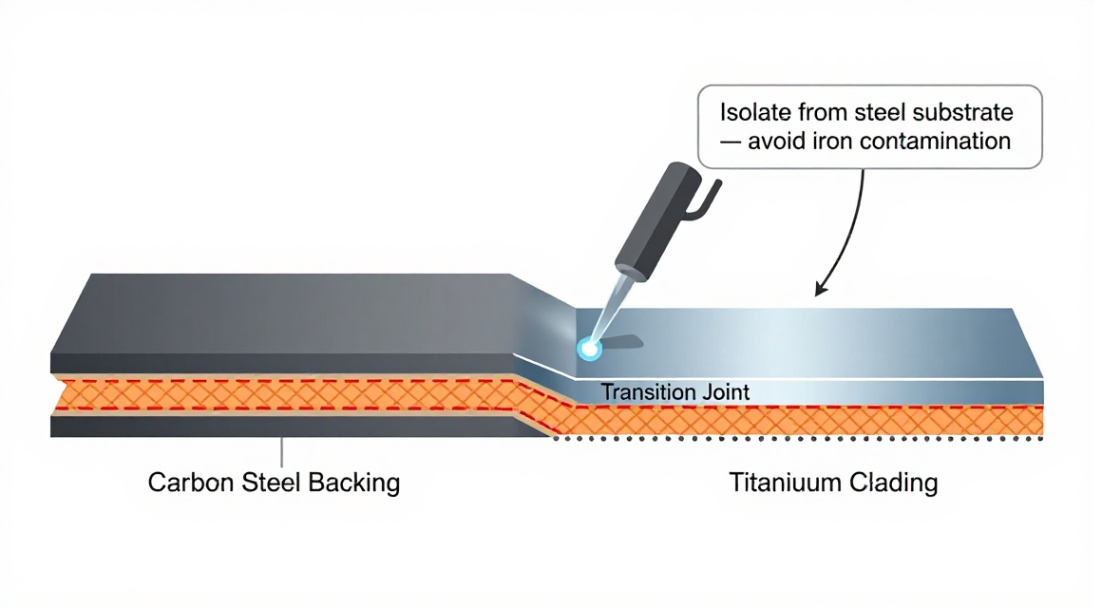
Here is the hard truth: Your welding crew must be qualified for reactive metal welding. This requires trailing gas shields. It requires clean rooms or at least clean tents. It requires meticulous interpass cleaning. If your fabricator treats titanium like stainless steel, the weld will fail. Plan for this. Train for this. Pay for this. The long-term savings dwarf the upfront training cost.
Weight and Structural Benefits You Cannot Ignore
Solid titanium vessels require thick walls to handle pressure. Titanium is less stiff than steel. You need more wall thickness. This costs money. With a titanium carbon steel clad plate for pulp and paper industry vessel, you use a thick carbon steel substrate (айту 60 мм) and a thin titanium layer (айту 3 мм). The steel handles all the pressure and mechanical loads. The titanium handles the corrosion. This is structurally superior. You get a stiffer, stronger vessel at a fraction of the cost of solid titanium. This is not opinion. This is mechanics.
NDT Testing: Verifying the Bond That Saves Your Mill
Trust but verify. Every plate must undergo rigorous non-destructive testing. Ultrasonic testing scans the entire bond interface for discontinuities. Shear testing destroys a coupon to confirm bond strength meets ASTM B898. A good clad plate supplier provides this data with every shipment. If they cannot, walk away.
You must also perform post-fabrication testing. After welding, inspect the titanium clad side with dye penetrant to find surface cracks. Use ultrasonic testing on the finished weld joints to check for lack of fusion. Do not skip this. A small undetected flaw in the bond line can grow into a catastrophic leak during a pressure cycle.
The Counterintuitive Truth: Titanium Clad Plate Is the Low-Risk Choice
Engineers often view titanium as exotic and risky. They stick with familiar stainless steel alloys. Familiarity breeds failure. Stainless steel fails predictably in these environments. You schedule downtime for replacement. You budget for repairs. This is accepted as normal. This is insanity.
А titanium carbon steel clad plate for pulp and paper industry vessel will outlast your stainless steel vessel by 3 дейін 5 times. The capital cost is higher. The lifecycle cost is dramatically lower. You reduce maintenance downtime. You eliminate corrosion-related safety hazards. You stop patching. You start producing. The only risk is continuing to use inadequate materials.
Your Next Move: Audit Your Corrosion Hotspots
Stop reading. Start acting. Go to your mill and look at your digester, your bleach tower, and your evaporator history. How many patches? How many unexpected shutdowns? Calculate the cost of those shutdowns. Multiply by ten. That is the potential savings from upgrading to titanium clad.
Specify ASTM B898 titanium carbon steel clad plate for your next replacement vessel. Demand ultrasonic test reports. Qualify your welders. Do not accept stainless steel substitutes. The data is clear. The logic is undeniable. Titanium carbon steel clad plate is not an exotic option. It is the financially responsible, technically superior answer for pulp and paper equipment that must survive aggressive chemical environments.
Жеткізуші
Metal Plate 4U is a trusted global metal composite panel supplier & manufacturer with extensive experience in providing super high-quality stainless steel, nickel alloy, мыс болат, and titanium steel composite plates. The company exports to many countries, such as the USA, Canada, Europe, UAE, South Africa, т.б. As a leading explosion bonded clad plate developer, Metal Plate 4U dominates the market. Our professional work team provides perfect solutions to help improve the efficiency of various industries, such as pressure vessels, жылу алмастырғыштар, кеме жасау, және химиялық өңдеу, create value, and easily cope with various challenges. If you are looking for metal composite panels or bimetal clad plates, бізге хабарласыңыз!