



Monel Composite Steel Plate Explosion Bonded to ASTM A516: The Direct Answer
Monel composite steel plate explosion bonded to ASTM A516 gives you the corrosion resistance of solid Monel 400 at a fraction of the cost, with the structural strength of a proven pressure-vessel steel. You get a metallurgically bonded, two-layer plate that handles aggressive chlorides, seawater, and sour gas environments without the weight and expense of a solid nickel alloy. In short: it solves a critical corrosion problem without breaking your budget.
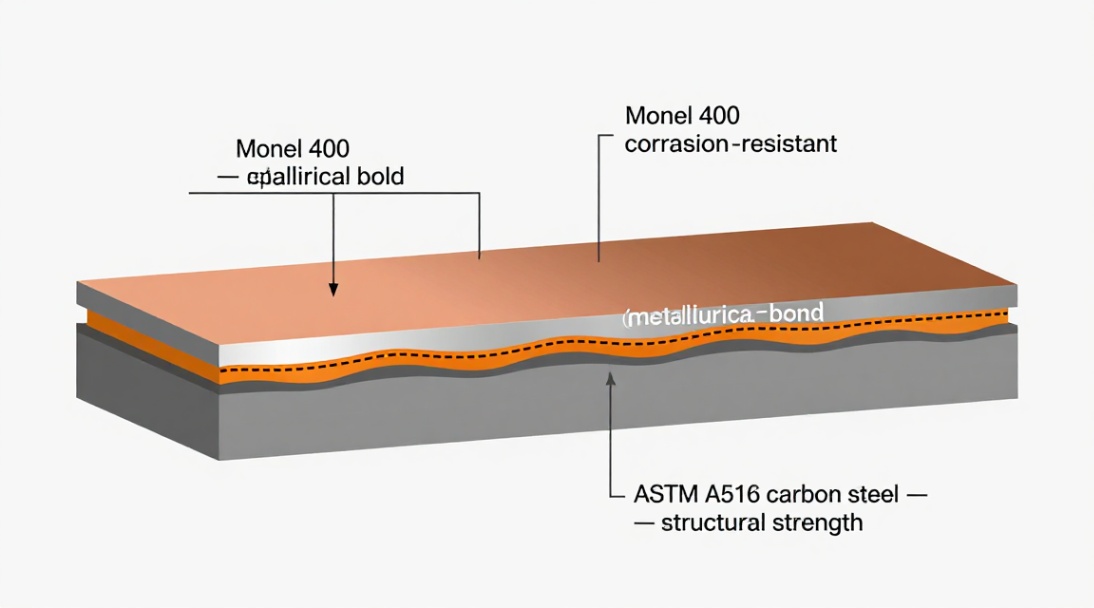
Monel composite steel plate explosion bonded to ASTM A516 is the go-to solution for heat exchangers, chemical reactors, and offshore equipment where both corrosion resistance and mechanical strength are non-negotiable.
What Makes Monel 400 So Effective Against Corrosion?
Monel 400 is a nickel-copper alloy (roughly 63% nickel, 32% copper, with small amounts of iron and manganese). Its magic lies in that copper content. In acidic and seawater environments, Monel 400 forms a passive film that resists pitting and stress-corrosion cracking. Reddit users in chemical processing forums often note that Monel 400 stands up to hydrofluoric acid and chlorides where stainless steel 316 would fail within months.
For a clad plate, this means the Monel layer takes the chemical attack, while the ASTM A516 backing provides the mechanical backbone. You get the best of both worlds.
Why ASTM A516 Grade 70 for the Backing Steel?
ASTM A516 Grade 70 is a carbon steel plate specifically designed for pressure vessels and boilers. Its key traits: excellent weldability, good notch toughness at low temperatures, and predictable mechanical properties under pressure. Engineers trust it for its consistent performance in heat exchangers and reactors. When you explosion bond Monel to A516 Grade 70, you inherit all those pressure-vessel qualifications.
Many Reddit discussions in the metallurgy and chemical engineering communities praise A516 Grade 70 for its ability to handle thermal cycling without delamination when properly bonded. That matters when your equipment cycles between ambient and 400°C.
How Does the Explosion Bonding Process Actually Work?
Explosion bonding isn’t magic—it’s controlled high-energy physics. Here’s the simplified sequence:
- A precisely calculated layer of explosive is placed on top of the Monel 400 plate.
- The Monel plate is positioned a specific standoff distance above the A516 steel plate.
- When detonated, the explosive accelerates the Monel plate to a high velocity toward the steel.
- The impact creates a jet of plasma that cleans both surfaces and forces them into a metallurgical bond—no filler metal, no heat-affected zone.
That last point is critical. Unlike weld overlay, explosion bonding introduces minimal heat. The heat-affected zone is virtually zero. This preserves the corrosion resistance of the Monel layer and the mechanical properties of the A516 backing. Reddit users who’ve worked with both methods consistently report that explosion-bonded plates show fewer corrosion failures at the interface.
What Are the Required Bond Strengths per ASTM B898?
ASTM B898 is the standard specification for reactive and refractory metal-clad plate. For Monel composite steel plate explosion bonded to ASTM A516, the key requirements are:
- Shear strength: Minimum 20 ksi (138 MPa) when tested per ASTM B898.
- Peel strength: No delamination after specified bend tests.
In practice, well-made explosion bonds routinely achieve shear strengths above 25 ksi. If you’re sourcing clad plate, ask for the shear test certificate. Experienced fabricators will run a shear test on every production lot.
One Reddit user in offshore oil & gas reported that their company requires both shear and peel tests on every batch, plus ultrasonic scanning of the entire bond interface. That level of testing is standard for critical service equipment.
How Do You Test the Corrosion Resistance of the Monel Layer?
Standard corrosion tests for Monel overlay in chloride and sour gas service include:
- ASTM G48 (pitting and crevice corrosion): Expose a sample to ferric chloride solution. No pitting after 72 hours is a typical pass criterion.
- ASTM A262 (intergranular corrosion): For sensitization testing, especially after post-bond heat treatment.
- NACE TM0177 (sour gas): Monel 400 has good resistance to sulfide stress cracking, but the clad interface must be free of defects that could trap H2S.
Reddit users in corrosion engineering groups often recommend performing dye penetrant testing on the clad surface after any fabrication steps—welding, grinding, or bending. A pinhole in the Monel layer can become a corrosion hotspot.
What About Weight and Cost Savings?
Solid Monel 400 costs roughly 4 to 6 times more per kilogram than ASTM A516 Grade 70. By using a composite plate where only the cladding is Monel, you cut material costs by 30% to 50% for large vessels. And because Monel is dense (8.8 g/cm³ vs steel’s 7.8 g/cm³), a solid Monel vessel would be both heavier and more expensive. Weight reduction means smaller foundations, lower transport costs, and simpler structural support.
For a heat exchanger shell that’s 3 meters in diameter and 10 meters long, the savings can easily exceed $100,000 in material alone. That’s real money.

Fabrication Considerations: Welding and Heat Treatment
Welding Monel composite steel plate explosion bonded to ASTM A516 requires attention to three points:
- Weld overlay compatibility: The recommended filler metal for welding Monel 400 to itself or to steel is ENiCu-7 (AWS A5.11). When attaching the clad side to other components, use the Monel-compatible filler to avoid galvanic corrosion.
- Post-bond heat treatment: If the vessel requires PWHT, keep the temperature below 620°C (1150°F). Above that, you risk sensitizing the Monel layer and reducing its corrosion resistance. Some codes allow a lower-temperature PWHT for A516 clad plates.
- Dilution concerns: During welding, keep the heat input low to minimize dilution of the Monel layer with the steel backing. Reddit users recommend a buttering pass with ENiCu-7 before the final weld.
One experienced fabricator posted that they always grind back the Monel layer at weld edges to expose the A516 steel, then weld using a transition joint. That avoids any chance of brittle intermetallic formation at the weld fusion zone.
Which NDT Methods Are Best for Monel Composite Steel Plate Explosion Bonded to ASTM A516?
Two NDT methods dominate for ensuring bond quality:
- Ultrasonic scanning (UT): A 100% scan of the bond interface is standard. Any unbonded area larger than 1 inch in diameter is typically flagged for repair. Phased-array UT gives even finer resolution of small disbonds.
- Dye penetrant (PT) of the clad surface: After fabrication, a PT test on the Monel surface reveals any cracks or pinholes caused by welding or bending. It’s quick, cheap, and catches problems before the vessel goes into service.
Reddit users in NDT groups stress that UT should be performed before and after any heat treatment. PWHT can sometimes cause disbonds at the interface if residual stresses are high.
Typical Applications: Where Does This Plate Shine?
You’ll find Monel composite steel plate explosion bonded to ASTM A516 in these critical roles:
- Heat exchangers: Tube sheets and shells handling seawater coolants or process fluids with chlorides.
- Chemical reactors: Hydrofluoric acid alkylation units, caustic soda concentrators, and phenol extraction columns.
- Offshore oil & gas: Separator vessels, coalescers, and produced-water treatment equipment where both sour gas and seawater are present.
- Desalination plants: Evaporator vessels and brine heater shells that see concentrated chlorides at elevated temperatures.
Explosion Bonded vs Roll Bonded Monel Composite: Which Is Better?
This is a common debate on Reddit’s materials science subreddit. Here’s the straight comparison:
Explosion bonding gives you a stronger, more consistent metallurgical bond. The interface is wavy and interlocked, which provides higher shear strength. Bond reliability is superior, especially for thicker plates (over 25 mm total). The downside: it’s a batch process, so production capacity is limited. Lead times can be 6 to 12 weeks.
Roll bonding is more scalable—you can produce long sheets continuously. But the bond strength is lower because it relies on diffusion rather than impact welding. Roll-bonded plates are more prone to edge disbonding, especially if the temperature isn’t tightly controlled. For critical pressure-vessel applications, most codes (like ASME Section VIII) prefer explosion bonding.
The consensus among experienced fabricators: use explosion bonding for high-integrity, thick-wall vessels. Use roll bonding for less critical cladding where cost is the driving factor and the service is moderate.
Your Next Step: Get a Quote and Test Certificate
You’ve read the deep analysis. Now it’s time to act.
If you’re planning a new heat exchanger, chemical reactor, or offshore vessel, contact a qualified ASTM B898 compliant supplier. Ask for:
- A material test certificate with shear strength data and UT scan results.
- Sample coupons for your own corrosion testing.
- Fabrication guidelines for welding and heat treatment.
Don’t settle for a generic composite plate. Demand Monel composite steel plate explosion bonded to ASTM A516 with full traceability. Your equipment will thank you in 20 years when there’s no corrosion, no leaks, and no unplanned shutdowns.
Ready to order? Call us today or fill out the form on this page. We’ll help you specify the exact cladding thickness, plate dimensions, and testing requirements for your project. Your success is our mission.
Supplier
Metal Plate 4U is a trusted global metal composite panel supplier & manufacturer with extensive experience in providing super high-quality stainless steel, nickel alloy, copper steel, and titanium steel composite plates. The company exports to many countries, such as the USA, Canada, Europe, UAE, South Africa, etc. As a leading explosion bonded clad plate developer, Metal Plate 4U dominates the market. Our professional work team provides perfect solutions to help improve the efficiency of various industries, such as pressure vessels, heat exchangers, shipbuilding, and chemical processing, create value, and easily cope with various challenges. If you are looking for metal composite panels or bimetal clad plates, please feel free to contact us!