



Does This Sound Like Your Situation?
You are designing a pressure vessel for a demanding service. The client specifies a high-cost aleación como inconel 625 or Hastelloy C276. But using that alloy for the entire wall thickness? That is a budget disaster. You need a custom size bimetal clad plate for pressure vessel lining — a strong, corrosion-resistant barrier bonded to a cost-effective carbon steel backing. But how do you choose the right one? The market is full of options. Get it wrong, and you risk bond failure, corrosion leaks, or project delays. Let us cut through the noise together.
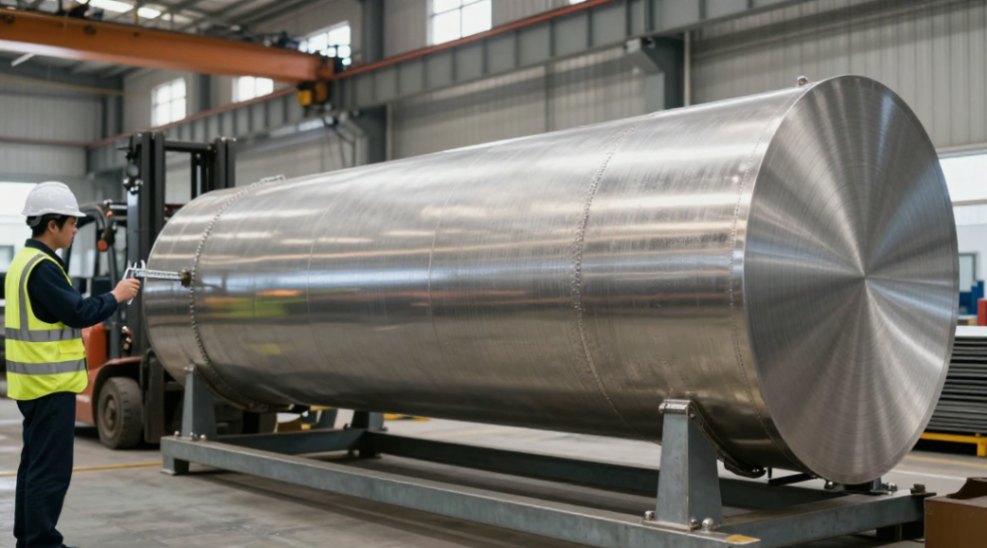
1. Metal común + Cladding Metal: The Foundation of Your Choice
Your selection starts with two materials. El metales comunes (backer) provides structural strength. El cladding metal (liner) fights corrosión.
Common Pairings for Pressure Vessel Lining
- Carbon steel + SS316L: Best for general corrosion resistance in chemical processes. Cost-effective and widely available.
- Carbon steel + Inconel 625: Handles aggressive high-temperature media and chloride stress corrosion cracking. A premium choice.
- Carbon steel + Hastelloy C276: For extremely corrosive environments with strong acids or oxidizing agents. The top-tier protector.
- Carbon steel + Titanio: Used in desalination or seawater service. Lightweight but demanding to bond.
Expert tip: Do not over-specify the cladding. If your fluid is mildly acidic at 80°C, SS316L will save you money. Save Hastelloy for the really nasty jobs.
2. Explosion Bonding vs. Unión por rollo: Two Roads to One Destination
These are the two main manufacturing methods for a custom size bimetal clad lámina for pressure vessel lining. They are not interchangeable. Know the difference.
Explosion Bonding (Explosive Welding)
- How it works: A controlled explosive charge drives the cladding metal onto the base metal at high velocity. The metals weld together on impact.
- Bond integrity: This is a true metallurgical bond. No filler metal. No heat-affected zone problems.
- Shear strength: Typically exceeds 140 MPa (20,000 psi). Far stronger than mechanical lining.
- Lo mejor para: Large plates, thick cladding layers, and difficult-to-weld metal combinations (p.ej., titanium to steel).
Unión por rollo
- How it works: Two or more metal layers are heated and passed through heavy rollers. Pressure and heat create the bond.
- Bond integrity: Bien, but can have lower shear strength than explosion bonding for some material pairs.
- Lo mejor para: Thinner plates, high-volume production, and simpler metal combinations (p.ej., SS304 on carbon steel).
The verdict: For critical pressure vessel lining where bond failure is not an option, explosión bonding wins every time. It delivers a consistent, high-strength bond over large custom sizes.
3. ASTM & ASME Compliance: Your Safety Net
Do not accept a custom size bimetal clad plate for pressure vessel lining without proper standards. These are your safeguards.
Key Standards You Must See
- ASTM A263: Stainless chromium steel clad plate.
- ASTM A264: Stainless chromium-nickel steel clad plate (p.ej., SS304, SS316).
- ASTM B898: Reactive and refractory metal clad plate (titanio, tantalio, circonio).
- ASME Section VIII Division 1: The pressure vessel code. It dictates how clad plates are used in vessel construction.
What this means for you: Ask your supplier for a mill test certificate (MTC) that explicitly references these ASTM standards. If they hesitate, alejarse.
4. Custom Dimensions, Thickness Ratio, and Flatness: The Devil Is in the Details
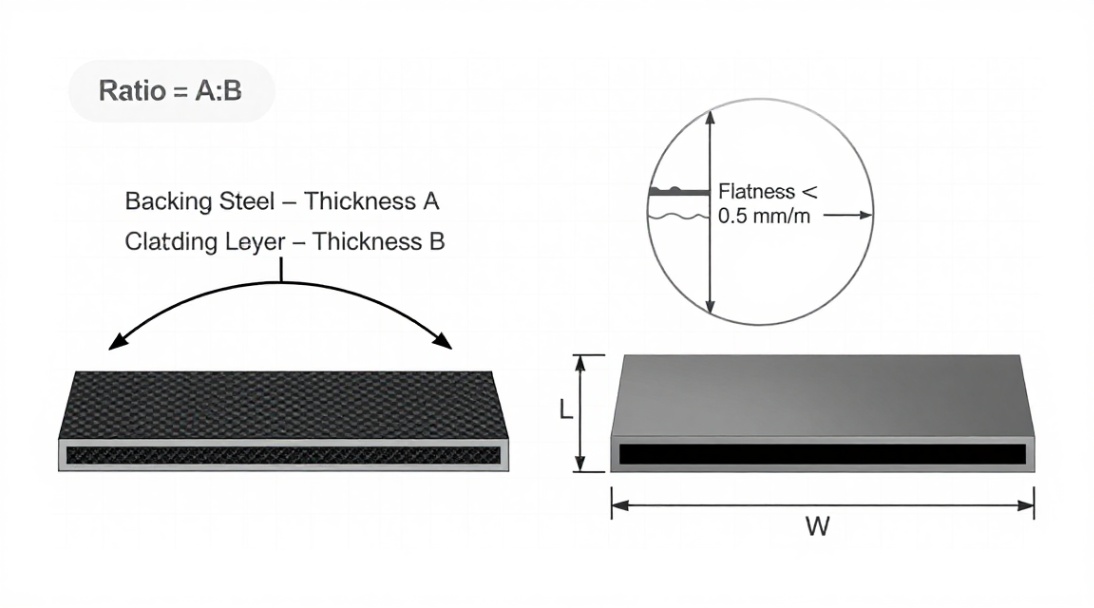
- Overall dimensions (length x width): Minimize welds on the vessel shell. Larger plates mean fewer seams.
- Thickness ratio (revestimiento / total): Typical cladding thickness is 2-5 mm on a 10-50 mm base plate. But you can go thicker if needed.
- Flatness tolerance: Pressure vessel shell forming requires tight flatness (p.ej., within 3 mm per meter). Warped plates cause fit-up nightmares.
Short punchy advice: Give the supplier a sketch. Include all dimensions. Then ask for aflatness guarantee in writing.
5. NDT Testing: Trust but Verify
Pruebas no destructivas (END) is not optional. It is the proof that your custom size bimetal clad plate for pressure vessel lining is sound.
Required Tests
- Ultrasonic Testing (UT): Scans the entire bond area for disbonds. Industry standard: less than 2% unbonded area, no single unbonded spot larger than 25 milímetros.
- Shear test: Destructive test on a sample coupon. Minimum shear strength per ASTM A264 is 140 MPa.
- Bend test: Ensures the clad layer does not separate during vessel forming.
Red flag: If a supplier sayswe do UT only on request,find another supplier. This is standard practise, not a value-add.
6. Selección de materiales: A Quick Cheat Sheet
Choosing the wrong cladding material is expensive. Here is your cheat sheet for common scenarios.
- General chemical processing: SS316L (buena resistencia a la corrosión, moderate cost).
- High-temperature chlorides or sour gas: Inconel 625 (resists pitting, agrietamiento, and oxidation).
- Strong mineral acids or flue gas desulfurization: Hastelloy C276 (nearly universal corrosion resistance).
- Seawater or brine: Titanio (immune to chlorides, bajo mantenimiento).
7. Fabrication Challenges: Corte, Perforación, and Welding
Your custom size bimetal clad plate for pressure vessel lining will need to be fabricated. Here is what trips people up.
Corte
- Plasma cutting works, but expect a wider heat-affected zone on the clad side.
- Abrasive waterjet is cleaner — no heat distortion. Preferred for tight tolerances.
- Shearing is possible for thinner plates but can delaminate the edges.
Drilling and Machining
- Use sharp carbide tools. The clad layer is hard and work-hardens quickly.
- Reduce feed rate when crossing the bond interface to avoid push-out.
Soldadura
- Weld from the clad side is best.
- Use a buttering layer first before filling with the cladding filler metal.
- Never weld directly to the carbon steel side if the clad is thin — you will melt through.
Data point: A major fabricator reported that poor weld procedures caused 15% of clad plate rejections in a single project year. Do not be that statistic.
8. Sourcing Your Supplier: A Checklist
Finding the right supplier for a custom size bimetal clad plate for pressure vessel lining is critical. Use this checklist.
- Do they hold ASTM certifications? Ask for a copy.
- Can they perform full UT in-house? Third-party UT is fine, but in-house capability means faster turnaround.
- What are their lead times for custom sizes? Industry average: 8-12 weeks for explosion-bonded plates.
- Do they have case studies in your industry? A supplier with power generation experience knows your weld prep needs.
- Ask for a quality plan. A real plan with inspection hold points, not a generic brochure.
One more thing: A cheap quote often hides low bond quality or skipped NDT. Price is important. But the cost of a vessel failure is far, far higher.
9. Corrosion Protection and Cost-Effectiveness: The Real ROI
Why use a custom size bimetal clad plate for pressure vessel lining at all? Two reasons.
- It saves money: You only use a thin layer of expensive alloy. The carbon steel backer is cheap and strong.
- It lasts longer: A metallurgical bond does not let corrosive media creep behind the liner (unlike mechanical lining).
Simple math from an IPC report: A 5 mm SS316L clad on 20 mm carbon steel costs roughly 50% less than a solid 25 mm SS316L vessel. And it performs the same. That is real savings.
Your Next Step
You now have the tools to evaluate a custom size bimetal clad plate for pressure vessel lining with confidence. You understand the materials, the methods, the tests, and the traps. Now go talk to your shortlisted suppliers. Send them your vessel sketch. Ask for a UT test report from a previous comparable job. Compare their quality plans side by side.
Need a trusted partner? We work with ASTM-compliant composite panel exporters who have proven NDT capabilities and lead times you can rely on. Contact us for a list of pre-vetted suppliers — no fluff, just names that deliver.
Proveedor
Metal Plate 4U is a trusted global metal composite panel supplier & manufacturer with extensive experience in providing super high-quality stainless steel, nickel alloy, acero al cobre, and titanium steel composite plates. The company exports to many countries, such as the USA, Canada, Europe, UAE, South Africa, etc.. As a leading explosion bonded clad plate developer, Metal Plate 4U dominates the market. Our professional work team provides perfect solutions to help improve the efficiency of various industries, such as pressure vessels, intercambiadores de calor, construcción naval, y procesamiento químico, create value, and easily cope with various challenges. If you are looking for metal composite panels or bimetal clad plates, no dude en contactarnos!